Core Muscle Exercise Info
Core muscle exercise is great for so many reasons: it's great for sports, it stabilizes you, and helps define your abs. This info will tell you why core exercise is important, what muscles are involved, and give you some core exercises.
Weight training is one of the best methods of strength training! If you want to start weight training safely and effectively, with the best info, diet, and routines, check out the 5 Day Beginner Weight Training Course!
So, onward!
Why Do Core Exercise?
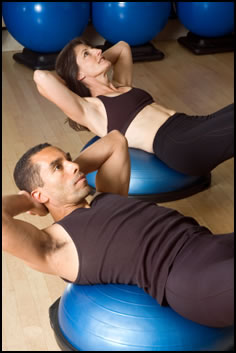
First off, core muscle exercise is great for sports. Many sports movements originate in the legs, and transferring the leg force up your torso & into your upper body is the job of your core.
When you're pushing on something (say, trying to push a car with a dead battery) you tense your core & hold your breath slightly - to pressurize your core and keep it tight. This is known as the Valsalva Maneuver[1], and it's your core's way of helping lower body force interact and assist the upper body, and vica-versa.
For walking, sports, wrestling, swordsmanship, or making a sharp turn while skiing down a mountain, your core muscles keep your body moving together. Functional core strength is a huge benefit.
So, basically, anyone and everyone can benefit from more core strength.
But, "what are the core muscles?" you ask?
The Core Muscles[2]
• Lumbar Spine Muscles
These include the transversospinalis group, erector spinae, quadratus lumborum, and latissimus dorsi. They go along the sides of your spine and stabilize your body.
• Abdominal Muscles
These include the rectus abdominus, external obliques, internal obliques, and transverse abdominus. They help with horizontal balance and move your upper body forward and back.
• Hip Muscles
The psoas, gluteus medius, gluteus maximus, and your the muscles in the back of your thigh (the posterior thigh muscles), which make up the hamstrings. These work to flex your lets at the hips, and to a lesser extent at the knees.
What're the Best Methods of Core Muscle Exercise?
First off, core muscle exercise and ab exercises aren't always the same thing. The abs are part of your core, but not all of it. The stability part of your core is more important than getting nice looking, cut abs. That's for later ;-)
At the most basic level, virtually any full body exercise works your core. At the beginning, learning to keep your core tight in a basic barbell squat develops better core muscle strength and sit-ups.
Moving on from there, the barbell clean and press, kettlebell exercise, compound exercises, and even the good old fashioned push-ups are great core muscle exercises.
Focus on moves that involve multiple planes. An example would be lifting a dumbbell from your left ankle to above your right shoulder, combining horizontal and vertical movement.
If you want to use core exercises to get a ripped six pack, check out myHow to Get Abs e-book. It contains exact, step-by-step instructions for how to get ripped, with precise exercise and diet info.
Getting a Stronger, More Stable Core
You've got the muscle knowledge, the reasons to do it, and the exercises. Whether its for sports, martial arts, or just better posture - get out there and start doing core exercise. It's worth it.
Oh, and be sure to sign up for the e-zine Starting Strong to get monthly strength training, exercise, and diet tips e-mailed to you - and access to the free e-book Train Smart, Eat Smart: Exercise Nutrition Hacks!
• Click here to learn more about Ab Exercises and Workouts!
OR
• Click here to leave 'Core Muscle Exercise Info' & go back to the Home-page!
References:
1. MedicineNet.com. "Definition of Valsalva Maneuver". (http://www.medterms.com/script/main/art.asp?articlekey=6250). Accessed February 18, 2010.
2. Power point presentation: "What Is The Core?" Jackie Williams, MS, LAT, ATC, Athletic Training Education Program Director. Department of Health, Physical Education, Recreation & Dance, College of Education at the University of Idaho. (http://www.educ.uidaho.edu/jwilliams/HS%20467/Core%20Stabilization.ppt). Accessed February 18, 2010.
Search CST...

|
Tweet Follow @Aaron_CST |


|
"About 2 weeks ago I read all the ab strengthening stuff on your site because I decided I wanted to be strong, instead of having a lot of belly fat. So I started eating healthier, running, exercising, you name it - everything your site said to do to help. Now I am noticing a real difference! Thank you for making this. :D xD" ~ Julia |
|
[This calorie calculator is] the most useful tool on the web that I can find… Also, I compared the calories calculated by your calculator to the calories calculated by the treadmill at my gym, and they're within a couple calories of each other, so yours is as accurate as we're going to get. REALLY AWESOME TOOL. I love it and depend on it. Thank you sooooo much for making this available." ~ Galit Sharon Marcus |
|
Thank you very much, I was too lean before 2 years (55 Kgs), after the gym now I'm 72kgs, all the muscles have developed... when someone hand shakes with me it can be squeezed easily, they're making fun of me! ~ Tamil Arasan |

New! Comments
Have your say about what you just read! Leave me a comment in the box below.