Treatments For Tennis Elbow
- Part 2 -
Since this article is so long, I've broken it into Treatments for Tennis Elbow - Part 2 (this page) and How To Treat Tennis Elbow - Part 1.
Weight training is one of the best methods of strength training! If you want to start weight training safely and effectively, with the best info, diet, and routines, check out the 5 Day Beginner Weight Training Course!
In this article I've tried to bring together all the helpful information I can about how to treat tennis elbow. There's info on how to use stretching, R.I.C.E., NSAIDs, and trigger points to cure your pain.
There's also info on the mainstream, surgical treatments for tennis elbow: cortisone injections and surgery. Try them only as a last resort, but know that they're there.
Read the info and try the different methods. There's a lot of good ideas here, and I used many of them to help myself. Though not the surgical ones, since those were not necessary after I had tried the others.
But no matter what you do with your body, whether it's just starting a beginner weight training program or biking, use correct body alignment and biomechanics.
While it's not one of the official 'treatments for tennis elbow', it'll keep you from really hurting yourself.
I hope these treatments for tennis elbow help you as much as they've helped me.
Treatments For Tennis Elbow - Part 2
Table of Contents:
- Why Do I Know Treatments For Tennis Elbow?
- R.I.C.E. (Rest, Ice, Compression, Elevation) Opens in a New Window
- N.S.A.I.D.s Opens in a New Window
- Stretching Opens in a New Window
- Trigger Point Index
- Cortisone Injection
- Surgery
- Conclusion
◆ Why Do I Know Treatments For Tennis Elbow?
How do I know treatments for tennis elbow? I had it, and it was royally painful and ten-thousand kinds of infuriating.
And now I do not have tennis elbow.
In the winter of 2007 I could barely hold a cup of tea without pain, and I was angry. It seemed like there were so many different chunks and pieces of info about various treatments for tennis elbow, but I only had a few of them.
However, through seeing unhelpful doctors and physical therapists and reading everything I could lay my hands on I was able to cure myself. I've got no pain, even today.
All the treatments for tennis elbow in the article are ones that I found through my painful research. Pain is a great motivator, but I hope I can make it much easier for you to be able to get painlessly moving again.
◆ Trigger Point Index (Continued From Part 1)
Extensors[3]
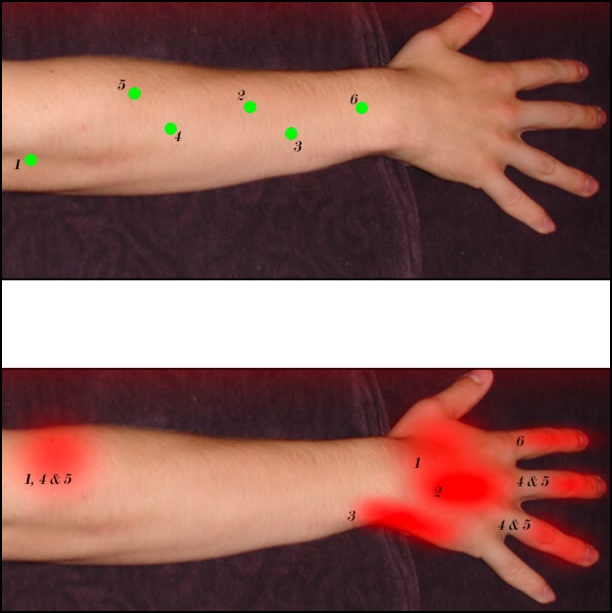
The hand extensors are made up of the Extensor Carpi Radialis Longus (#1), Extensor Carpi Radialis Brevis (#2), Extensor Carpi Ulnaris (#3), the Extensor Digitorum (#4 & #5), and The Extensor Indicis (#6). That's a lot of Latin, but it's just six muscles.
While the Branchioradialis, Supinator, and Aconeus muscles also fall into the category of hand extensor muscles, they are unique enough to warrant separate sections.
The extensors have the job of bending back the hand and the fingers. Any gripping action or lifting of the hand involves them. They attach to the Lateral Epicondyle of your humerus and have long tendons that attach the muscles to the fingers in your hand.
The Extensor Carpi Rasialis Longus (#1) is one of the muscles responsible for bending the hand back toward the thumb, like when you lift a glass to drink. It is also attached to your index finger.
The Extensor Carpi Radialis Brevis (#2) is attached to your middle finger. It's responsible for raising the middle finger.
The Extensor Carpi Ulnaris (#3) is responsible for movements involving cocking the wrist back and lifting of the little finger. Extensor Digitorum (#4 & #5) has three different tendons which attach to and aid in the movement of the middle, ring, and little fingers.
The Extensor Indicis (#6) attaches to the index finger and is primarily responsible for the index finger’s movement.
A good way to find which muscle you’re pushing on if you’re confused is to place one hand on the back of the forearm while lifting a single finger. This will give you a good feel for which finger muscle is doing what.
To massage these points, instead of working them with the fingers of your other hand try placing one forearm on a table the use the other arm’s elbow to press on the trigger points. This will save the muscles in the massaging forearm, so that you don't build trigger points in that arm while giving the other a massage.
Use care if your forearm is especially tender. By using the bony end of your elbow to massage your forearm and leaning when you massage (using your upper body weight instead of muscle) you can give your massaging hand a rest.
Place a good amount of concentrated pressure wherever you need to massage out the painful trigger points. Track down those painful parts of your muscles and get to work massaging them.
Supinator[4]
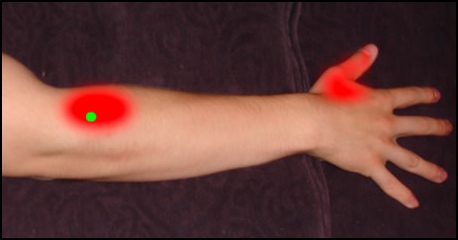
This muscle is responsible for turning the hand upward, and assists the biceps when lifting an object upward. It is made up of two different planes of muscle fiber that work together, and between them lies the radial nerve.
When the two layers of muscle get tight and hard, it sometimes compresses the radial nerve. This leads to pain, tingling, and numbness in the hand. By massaging these muscles to relaxation, you can relieve the tension on the radial nerve.
Supraspinatus[5]
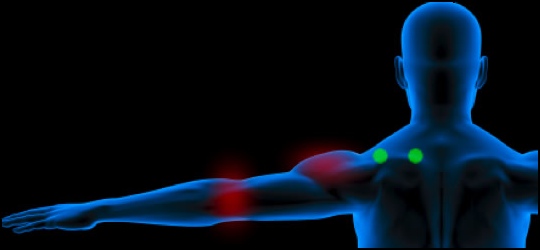
The Supraspinatus lifts the arm and works with the other three rotator cuff muscles to hold the shoulder together. Trigger points in this muscle will make your arm painful and weak, as well as making any overhead movements painful or impossible.
The Supraspinatus is located right at the top of the shoulder blade.
To massage this muscle, reach down and to the opposite hip with the arm connected to the shoulder you want to massage. This will shift the shoulder blade outward and give you access to the muscle.
Use some sort of massage tool to get back there and apply pressure to the muscle (a Theracane works great). If you want something cheaper (like me) place a tennis or lacrosse ball in a sock and lower it behind your back till it touches your painful muscle. Then lean back against a wall, massaging the muscle with the pressure from leaning against the wall.
For another method, find a doorway or other right-angle in your house. You can press this muscle and others in your shoulder against it if you have no other means of massaging it.
Triceps[6]
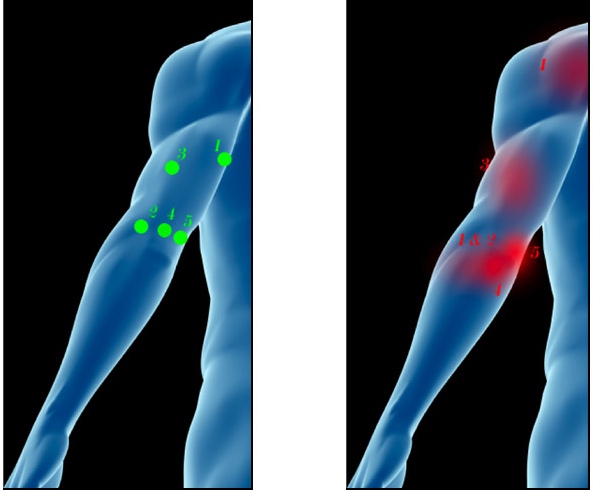
This is the large muscle on the back of your upper arm, responsible for straightening your arm. It attaches to your forearm bone (the ulna) and is one of the muscles most responsible for pain in any repetitive ‘casting’ or ‘swinging’ motion, seen in tennis, fly-fishing, and Japanese swordsmanship.
Hold your arm in front of you and move your forearm back and forth as if doing a ‘karate chop’. Use your other hand to feel the tricep on the back of your arm relaxing and contracting.
There are several different trigger points that are common to the triceps. They are numbered in the diagram above, along with their corresponding referred pain patterns. It should be noted that if any of these trigger points are particularly well established, they can refer pain to the little and ring fingers.
In addition to this, if number 3 is tight enough it can compress the radial nerve, and number 4 will make the elbow quite sensitive. Also, some referred pain goes to the inside of the elbow, which is commonly mistaken for ‘golfer’s elbow’.
There you have it, all the muscles that could cause your tennis elbow pain. You can now find out more information about trigger points or look at the more orthodox methods of tennis elbow treatment.
◆ Cortisone Injection to Cure Tennis Elbow
Yes, cortisone injection(s) are another of the effective treatments for tennis elbow. But it still isn't the best option, and there are a lot of collateral issues with cortisone injections that need to be taken into account.
The body naturally produces cortisone in tiny amounts at the adrenal gland. Cortisone, and the synthetic copy used for clinical treatments, brings down inflammation and reduces pain.
If rest, icing, and NSAIDs (non-steroidal anti-inflammatories) haven’t worked, the next step is to try cortisone injections.
A cortisone injection is a steroid injection right at the site of the inflamed tendon in the elbow. The pain reduction is caused by the injection bringing down the inflammation, so the cortisone actually helps with the root cause of tennis elbow.
After a cortisone injection, the pain in your elbow should dramatically drop in the next few days. A one to two week recovery period is recommended, after which a gradual rehabilitation program should be carried out.
One of the issues with the cortisone injection is that after 6-8 weeks, the beneficial effects of he cortisone begin to wear off. The tendon inflammation will have gone down or vanished during that time, but if no corrections are made to your sports form and you do nothing for a long term solution, the tennis elbow may just come back.[7]
Also, multiple cortisone injections can actually weaken the tendon, so this approach should not be tried more than 2-3 times at the most.[8] Further, some conflict has arisen about whether or not just resting your elbow and not having the injection is just as good as the cortisone injection.
That being said, with the correction of your sports form and physical therapy to help deal with the root of the problem (bad biomechanics), a cortisone injection can help you effectively recover from tennis elbow. If nothing else non-invasive is working, this is the next treatment to try.
◆ Tennis Elbow Surgery
Tennis elbow surgery is the very last one of the treatments for tennis elbow to try. Only after attempting all other methods of treating your tennis elbow should you resort to surgery.
I cannot stress highly enough that with rest, icing, trigger points, and even cortisone injections there is a high likelihood that you will be able to cure your tennis elbow without surgery.
Your doctor should wait at least 6 months after you have been trying non-invasive treatments before recommending surgery. Cortisone injections should also be tried prior to a full surgical intervention.
That being said, if the worst happens and you have debilitating pain that will not go away, you should look into surgery. These days there are two kinds of tennis elbow surgery: one involves an incision made behind the elbow joint and the other is arthroscopic surgery.
When you go in for surgery, the surgeons will take several actions when operating. They will...
- Remove you inflamed tendon and replace it with a new, artificial tendon,
- Clean out and remove any scar tissue formed in the inflamed area, and/or
- Drill a small hole in the bone near the inflammation to increase blood supply to the region.
You will not need to stay in the hospital overnight, and it will take you 3 - 6 weeks to initially recover from the operation. 2 - 3 months after the operation is when you should expect to be able to begin playing again.[9]
You will also need to stretch your elbow to restore your range of motion, and probably see a physical therapist for your rehabilitation and recovery. If have to choose tennis elbow surgery as the final one of your treatments for tennis elbow, I wish you the best.
◆ Conclusion
These are your different treatments for tennis elbow.
I hope that you can cure it with the noninvasive methods I've outlined. Trigger points and stretching worked brilliantly for me, and I didn't have to have surgery or cortisone injections.
Correct biomechanics can help too, and are important if you're a hardcore athlete, or even just starting a beginner weight training program. Doing whatever you're doing the right way will keep you from hurting yourself.
All this being said, consult with your doctor. He or she will have the best ideas for how to help you, and which treatments for tennis elbow to use.
Oh, and be sure to sign up for the e-zine Starting Strong to get monthly strength training, exercise, and diet tips e-mailed to you - and access to the free e-book Train Smart, Eat Smart: Exercise Nutrition Hacks!
• Click here to learn more about delayed onset muscle soreness and Treating Muscle Aches & Pains!
OR
• Click here to leave 'Treatments For Tennis Elbow - Part 2' & go back to the Home-page!
Treatments For Tennis Elbow - Part 2
References:
3. Davies, Clair. 2004. The Trigger Point Therapy Workbook: Your Self-Treatment Guide For Pain Relief. Oakland, CA: New Harbinger Publications. Pp. 108-115.
4. Ibid. Pp. 110.
5. Ibid. Pp. 84-85.
6. Ibid. Pp. 97-98.
7. Levy, Allan M., and Mark Fuerst. 1993. Sports Injury Handbook: Professional Advice For Amateur Athletes. New York: John Wiley. Pp. 82.
8. Ibid.
9. Micheli, Lyle J., and Mark Jenkins. 1995. The Sports Medicine Bible: Prevent, Detect, and Treat Your Sports Injuries Through The Latest Medical Techniques. New York, N.Y.: HarperPerennial. Pp. 239.
Search CST...

|
Tweet Follow @Aaron_CST |


|
"About 2 weeks ago I read all the ab strengthening stuff on your site because I decided I wanted to be strong, instead of having a lot of belly fat. So I started eating healthier, running, exercising, you name it - everything your site said to do to help. Now I am noticing a real difference! Thank you for making this. :D xD" ~ Julia |
|
[This calorie calculator is] the most useful tool on the web that I can find… Also, I compared the calories calculated by your calculator to the calories calculated by the treadmill at my gym, and they're within a couple calories of each other, so yours is as accurate as we're going to get. REALLY AWESOME TOOL. I love it and depend on it. Thank you sooooo much for making this available." ~ Galit Sharon Marcus |
|
Thank you very much, I was too lean before 2 years (55 Kgs), after the gym now I'm 72kgs, all the muscles have developed... when someone hand shakes with me it can be squeezed easily, they're making fun of me! ~ Tamil Arasan |

New! Comments
Have your say about what you just read! Leave me a comment in the box below.