Super Slow Weight Training!
Super slow weight training has some adherents that follow it religiously. Others think it's a convenient way to focus on the movement and not on how much weight you lift.
Weight training is one of the best methods of strength training! If you want to start weight training safely and effectively, with the best info, diet, and routines, check out the 5 Day Beginner Weight Training Course!
- What is Super Slow Weight Lifting? -
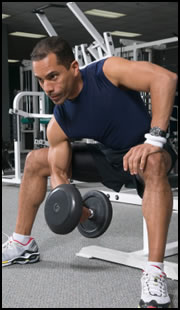
SuperSlow™ weight training was popularized in the 1980s by Ken Hutchins. Super slow weight training is, unsurprisingly, the practice of lifting weights really slowly. Lifts take 15 seconds to do, 10 seconds down and 5 seconds up.[1]
The emphasis is on lifting slowly, using correct form, and really feeling the weight as you lift it. And no cheating with momentum - ALL the work will be done by your muscles alone.
Since there are so few repetitions, and they are done so slowly, many times a set will have no more than 3 - 5 repetitions in it.
Pros:
• Good For Biomechanics And Rehab
If you're having trouble with form, try doing it super slow weight training. You'll have the time to perfect your form and keep from torquing or pulling your back with any fast movements.
And for rehab, super slow is great for focusing on just one muscle or muscle group. It'll really work that one part of your body.
• Your Muscles Do All The Work
Since you are going so slow, there's no momentum. Thus, you focus on lifting the weight without cheating with momentum and muscles you shouldn't be using. And there's a lot less risk of injury when you're going so slowly and carefully.
Cons:
• Lift Heavy
If you're really building strength, you should be lifting heavy weight. And if you're lifting heavy weight, REALLY HEAVY WEIGHT, then you will be lifting pretty slowly and doing only a few repetitions of each exercise.
So, when you're close to working with your maximum weight, you'll already be going pretty slow and you’ll already be doing fewer reps. Super slow might not change much of your workout if you're already lifting near your limit.
• Hard to Time
When you're doing a bench press you're not looking at your watch. Or at least, I hope you're not - otherwise the press isn't going to, uh, press. So, timing you super slow sets will be hard.
You can mentally count in your head, which works - but there will be that subconscious temptation to speed up when you're tired on your last reps. Out loud? You won't have the breath.
The best bet is to have a friend timing it for you, or get an athletic watch that you can have beep at 10 and 5 second intervals. I've found those to be the most effective ways to do super slow sets.
• Boring
Lifting slowly can be boring. This is a personal thing - but it can be tedious for some people.
- Is It For You? -
The only way to know if super slow weight training is for you is to try it. Don't feel religiously obligated to try the timing scheme above- try out others like 10 seconds down, 10 seconds up, 5/10, 8/8, etc.
Also, if you're recovering from an injury and want to lower the possibility of additional injury, try it slow. You won't get injured then unless you have far too much weight or your form is laughably bad.
While your workout shouldn't be relaxed and fun like eating ice cream, you'll probably stick with it if you enjoy the kind of workout that you're doing. Whatever it is, super slow strength training or not, do something that gets your blood boiling!
Oh, and be sure to sign up for the e-zine Starting Strong to get monthly strength training, exercise, and diet tips e-mailed to you - and access to the free e-book Train Smart, Eat Smart: Exercise Nutrition Hacks!
• Click here to learn more about Weight Training for Beginners!
OR
• Click here to leave 'Super Slow Weight Training!' & go back to the Home-page!
Super Slow Weight Training!
References:
1. Johnson-Cane, Deidre, Jonathan Cane, and Joe Glickman. 2005. The Complete Idiot's Guide to Weight Training. Indianapolis, IN: Alpha. Pp. 194.
Search CST...

|
Tweet Follow @Aaron_CST |


|
"About 2 weeks ago I read all the ab strengthening stuff on your site because I decided I wanted to be strong, instead of having a lot of belly fat. So I started eating healthier, running, exercising, you name it - everything your site said to do to help. Now I am noticing a real difference! Thank you for making this. :D xD" ~ Julia |
|
[This calorie calculator is] the most useful tool on the web that I can find… Also, I compared the calories calculated by your calculator to the calories calculated by the treadmill at my gym, and they're within a couple calories of each other, so yours is as accurate as we're going to get. REALLY AWESOME TOOL. I love it and depend on it. Thank you sooooo much for making this available." ~ Galit Sharon Marcus |
|
Thank you very much, I was too lean before 2 years (55 Kgs), after the gym now I'm 72kgs, all the muscles have developed... when someone hand shakes with me it can be squeezed easily, they're making fun of me! ~ Tamil Arasan |

New! Comments
Have your say about what you just read! Leave me a comment in the box below.