Use Isometric Stretching To Gain Significant Flexibility
Isometric stretching (IS) is one of thefastest and most effective ways of developing flexibility. In a matter of days or weeks you can become substantially more flexible, and develop strength in your flexible limbs.
Weight training is one of the best methods of strength training! If you want to start weight training safely and effectively, with the best info, diet, and routines, check out the 5 Day Beginner Weight Training Course!
I personally think this technique is awesome! So…
What's Stretching Isometrically?
Isometric stretching is where you move into a position to stretch, hold the stretch, and tense (isometrically contract) your stretched muscles, and then relax and stretch some more. Pretty simple, on the face of it.
Isometric means "same distance", which is a reference to how you contract your muscles.[1] You contract your stretched muscles without moving - like how you contract your bicep to show off, while keeping your arm in one position.
Alternatively, while stretching your legs on the floor you might grab your foot. This would allow you to tense your calf, trying to point your foot away from your leg, while you use your hand to hold your foot back. Then you relax the calf and stretch it even further.
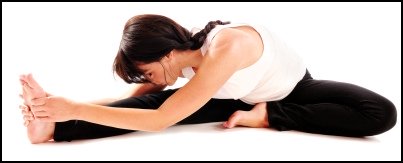
Isometric stretches are typically held in their contracted position longer than PNF stretches, a similar stretching technique.[2] PNF stretches are also more precise about different muscle contractions and how you should move to increase your range of motion (ROM).
Why Does Stretching Isometrically Work?
It's virtually impossible to tense all of your muscle fibers at once, even when you're trying with all your might. This is how your body keeps you from damaging yourself.
In an isometric muscle contraction, some fibers in the muscle are pulled on by the contracting muscle - stretching the resting muscle fibers & contracting the tensing fibers.
In the isometric contraction the contracting fibers pull on the resting fibers, stretching them. The resting fibers then get stretched more, and when you subsequently relax your muscle the contracting fibers relax as well and allow your muscle to lengthen more than normal.[3]
Giving you greater flexibility almost immediately. Pretty cool (and useful) science!
Advantages?
- It's more effective than active or passive stretching alone.[4]
- It builds strength in the tensed muscles.
- It seems to decrease the pain associated with stretching.[5]
- IS is great for speed training. The tension from the isometric contraction strengthens the muscles at the very end of the range of motion you're working.
- This is extremely useful if you need strength and power at the end of your range of motion. Say for kicking, punching, leg movements in dance, or keeping a joint aligned.[6]
- WARNING -
Isometric stretches should not be done by children or adolescents. Their bones are still growing and IS could damage their connective tissue.[7][8]
How To Do Isometric Stretching...
First, make sure you're thoroughly warmed up before you try these stretches. This'll make the stretching easier, and you'll gain more range of motion.
Also, do no more than 1 isometric stretching session a day per muscle group.[9] IS puts a great strain on the muscles being stretched and you don't want to hurt yourself with overzealous enthusiasm. Trust me, isometric style stretching will build your flexibility fast with just 1 session a day.
Use a floor, wall, or your own limbs to apply resistance to your isometric contraction. Tense your muscles, and make sure you don't move when you're tensing up.
- The IS Method -
- Take a stretching position, as if you were doing a normal (static) stretch.
- Tense your muscles for 7-15 seconds.
- Relax for 20+ seconds, stretching as far as possible into your increased range of motion.[10]
That's all there is to it. Really.
So simple, and yet so effective at building range of motion and flexibility. Give it a try!
Oh, and be sure to sign up for the e-zine Starting Strong to get monthly strength training, exercise, and diet tips e-mailed to you - and access to the free e-book Train Smart, Eat Smart: Exercise Nutrition Hacks!
• Click here to learn more about Exercise Stretches & Flexibility!
OR
References:
1. Chabut, LaReine. 2007. Stretching for Dummies. -For Dummies. Chichester: Wiley. Pp. 16.
2. Walker, Brad. 2007. The Anatomy of Stretching. Chichester, England: Lotus Pub. Pp. 23.
3. Appleton, Brad. 2001. Stretching and Flexibility: Everything You Never Wanted to Know. Roots & Wings. Pp. 20.
4. Ibid. Pp. 19.
5. Ibid.
6. Weimann, Ted. 2000. Warrior Speed. Hartford, CT: Turtle Press. Pp. 176.
7. Appleton. Pp. 19.
8. Walker. Pp. 23.
9. Appleton. Pp. 19.
10. Ibid.
Search CST...

|
Tweet Follow @Aaron_CST |


|
"About 2 weeks ago I read all the ab strengthening stuff on your site because I decided I wanted to be strong, instead of having a lot of belly fat. So I started eating healthier, running, exercising, you name it - everything your site said to do to help. Now I am noticing a real difference! Thank you for making this. :D xD" ~ Julia |
|
[This calorie calculator is] the most useful tool on the web that I can find… Also, I compared the calories calculated by your calculator to the calories calculated by the treadmill at my gym, and they're within a couple calories of each other, so yours is as accurate as we're going to get. REALLY AWESOME TOOL. I love it and depend on it. Thank you sooooo much for making this available." ~ Galit Sharon Marcus |
|
Thank you very much, I was too lean before 2 years (55 Kgs), after the gym now I'm 72kgs, all the muscles have developed... when someone hand shakes with me it can be squeezed easily, they're making fun of me! ~ Tamil Arasan |

New! Comments
Have your say about what you just read! Leave me a comment in the box below.